
If you’re learning digital marketing, you’ve likely come across the “famous five” – Panda, Penguin, Hummingbird, RankBrain, and BERT.
These are often discussed, but Google has introduced many more updates that subtly changed how websites rank.Understanding these updates gives you a clearer picture of how search works and helps you build SEO practices based on actual ranking principles rather than assumptions.
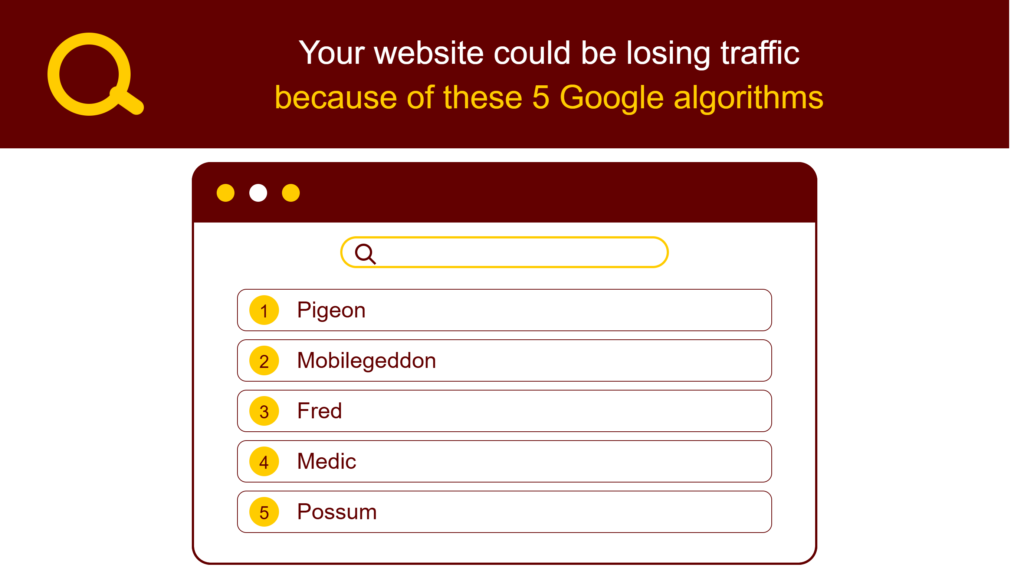
Here are five more algorithm updates that are worth adding to your SEO vocabulary.
1.Pigeon – Local Search Gets Smarter (2014)
Before 2014, local search results on Google often felt separate from the rest of the search engine – as if “near me” searches followed different rules.
Pigeon changed that by aligning local rankings more closely with Google’s main ranking signals.
After this update, the chances of a business appearing in local results depended on several factors: how close it was to the searcher, how relevant it was to the search query, the strength of its Google Business Profile, and the overall quality of its website.
Why it matters today: If you’re helping a local business with SEO, Pigeon is the reason an accurate, well-optimised Google Business Profile is essential – it’s not just a directory listing, it’s a key ranking factor.
2.Mobilegeddon – The Mobile-First Wake-Up Call (2015)
By the mid-2010s, more people were using mobile devices than desktops, but many websites were still built for desktop screens.
Google’s Mobile-Friendly Update – known as “Mobilegeddon” by the SEO community – made mobile-friendly design a ranking factor.
Websites that loaded quickly, resized well, and were easy to navigate on smaller screens received better rankings in mobile search.
Websites that didn’t often dropped in rankings, even if their desktop versions were good.
Why it matters today: Mobile-first isn’t just a trend anymore – it’s the standard.
Any site or landing page should be tested on mobile before any desktop improvements are considered.
3.Fred – Cracking Down on Ad-Stuffed, Low-Value Content (2017)
Fred is one of Google’s more casually named updates (the SEO community gave it the name since Google didn’t confirm many details).
It targeted websites that focused more on ad revenue than on delivering value to readers – articles with lots of ads and little real content.
Pages affected by Fred often followed a pattern: content created primarily to get clicks and ad impressions, rather than to answer a user’s question.
Why it matters today: Fred shows that monetisation and content quality must go hand in hand.
If a page looks like it exists mainly to serve ads, it can hurt rankings, not just user experience.
4.Medic – Raising the Bar for Trust (2018)
The Medic update was a broad core update, but it had the biggest impact on health, medical, financial and other “Your Money or Your Life” (YMYL) websites – pages where incorrect information could harm someone’s health, safety or finances.
Medic made Google place more importance on E-A-T – Expertise, Authoritativeness, and Trustworthiness.
Sites offering medical or financial advice without proper credentials or credible sources faced significant ranking drops, even if the content wasn’t technically wrong.
Why it matters today: For YMYL topics, “who wrote this and can they be trusted” is just as important as “what does this page say.” Author bios, credentials, and references aren’t just extra details – they are ranking signals.
5. Possum — Making Local Results More Diverse (2016)
The Possum update, released in 2016, reworked how Google handled local search results. Before this update, users often saw several nearly identical listings from similar businesses clustered in the same area, while other relevant businesses barely showed up at all.
Possum filtered out a lot of that duplication and gave businesses just outside a city’s official boundary a fairer shot at appearing in local results if they were genuinely relevant to the searcher. It also factored in the searcher’s precise location more closely, so two people searching from different spots in the same city could see slightly different local results.
Why it matters today: Possum is a reminder that local rankings depend on more than just having a listing — accurate, well-maintained local information and genuine relevance matter more than trying to blanket every nearby search term.
Conclusion
Updates like Pigeon, Mobilegeddon, Fred, Medic, and the Helpful Content Update have gradually brought Google’s search results closer to what users truly need — accurate local information, mobile-friendly websites, content with fewer ads, reliable information, and real value instead of just keyword-focused strategies.
For those learning SEO, understanding these updates makes it easier to create websites and content that remain aligned with Google’s standards over time.